
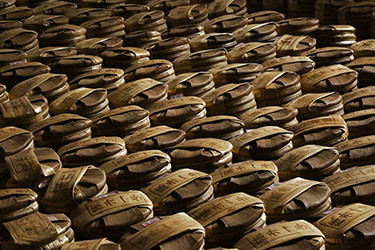
In puerh tea discussions, Guangdong storage and Kunming storage are often simplified into a binary opposition of “wet storage versus dry storage.” From the perspective of a Chinese tea vendor who has long worked with tea sourcing and storage, this framing is far too simplistic and does not reflect how puerh tea actually evolves in practice.
Storage is not a fixed category but a continuous process shaped by climate, handling, and time.
Climatic Differences and General Characteristics
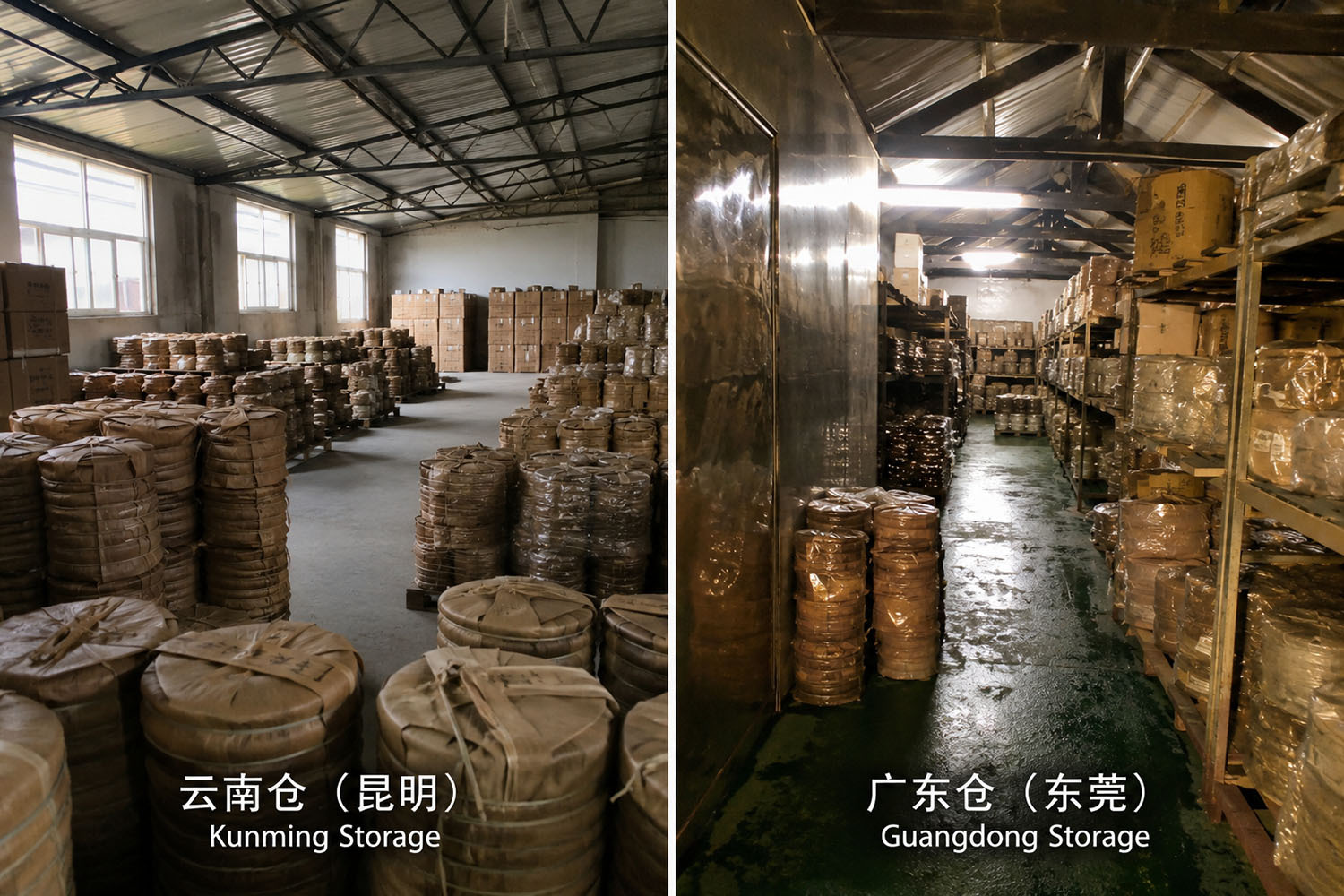
Kunming and Guangdong represent two very different climatic environments.
Kunming is relatively dry and mild, with stable humidity throughout the year. Tea stored in this environment tends to age more slowly and retain more of its original aromatic structure and bitter backbone. The tea often feels clearer in aroma expression, with a more linear structure, especially in the early and mid stages of aging.
Guangdong is warmer and significantly more humid. This accelerates the transformation of puerh tea, allowing it to reach a more integrated and mature profile more quickly. Bitterness softens earlier, texture becomes rounder, and deeper notes such as aged wood, camphor, dried fruit, or mild medicinal sweetness tend to appear sooner.
However, these are only broad tendencies. In real practice, storage conditions vary widely even within the same region.
Practical Storage Experience and Common Misunderstandings
From an operational point of view, Kunming storage is often misunderstood as simply “the drier the better.” In reality, excessive dryness or lack of air exchange can also cause problems. Tea may retain aroma but lose structural depth, resulting in a thin or flat body over time. Proper Kunming storage requires balance rather than extreme dryness.
Guangdong storage, on the other hand, is often misunderstood internationally as being equivalent to heavy or problematic wet storage. In reality, modern Guangdong storage exists on a wide spectrum. When properly managed, it can produce clean, stable aging with good depth and texture. The main issue is not humidity itself, but stagnation caused by poor airflow or excessive storage density. This can lead to a “stuffy” character that requires time and controlled airing to resolve.
In actual practice, storage is rarely static. Many teas move between different environments during their life cycle. It is common to place tea in a more humid environment in the early stage to help it open up, and later transfer it to a drier environment for slower maturation. This staged approach is often more balanced than relying on a single storage condition throughout.
How to Identify Storage Style in Practice
When evaluating storage, aroma alone is not enough. A more reliable assessment comes from observing multiple aspects together.
Kunming-stored teas typically present a clearer and more direct aromatic profile. The liquor is often lighter in color, and the structure feels more linear, with a relatively straightforward progression from initial sip to aftertaste. The overall impression is clarity and separation, with slower integration over time.
Guangdong-stored teas usually show a deeper liquor color and a thicker mouthfeel. The entry is softer and more rounded, and although the aroma may be less high-pitched, it tends to create a stronger coating and persistence in the mouth. The development in the mid and late palate is often more noticeable.
These are tendencies rather than fixed rules, as storage is only one factor among many.
Material, Compression, and Final Structure
It is important to emphasize that storage alone does not determine the final character of a puerh tea. Compression method, raw material quality, and age all play significant roles.
A lightly compressed or finer material tea may retain clarity even under Guangdong storage, while a tightly compressed tea may remain closed even in Kunming conditions. This is why storage labels should always be interpreted together with the tea’s physical structure and origin.
Another often overlooked aspect is the de-storage or airing phase, especially for Guangdong-stored teas. Before entering the market, many teas undergo a period of ventilation and rest to allow accumulated storage notes to dissipate. Without this step, the tea may appear unfinished, which contributes to misunderstandings about southern storage.
Conclusion
Kunming storage and Guangdong storage are not opposing systems but different speed profiles within the same natural aging process. Kunming emphasizes slower structural preservation and clarity, while Guangdong emphasizes faster integration and earlier maturity. Experienced practitioners do not treat either as superior; instead, they adjust storage decisions based on the characteristics of each tea.
Ultimately, a good puerh tea is not defined by the place it was stored, but by whether its evolution over time achieves balance, coherence, and stability. Storage is not a static label but a dynamic process shaped by time, environment, and the material itself.